
/Marketplace
Last updated Jul 2, 2026by
The Retail Control Plane is a Model Context Protocol (MCP) server that turns a retailer’s demand and inventory signals into governed, audit-defensible replenishment recommendations. It is built for the moment a style starts selling faster (or slower) than planned — the window in which margin is won or lost.
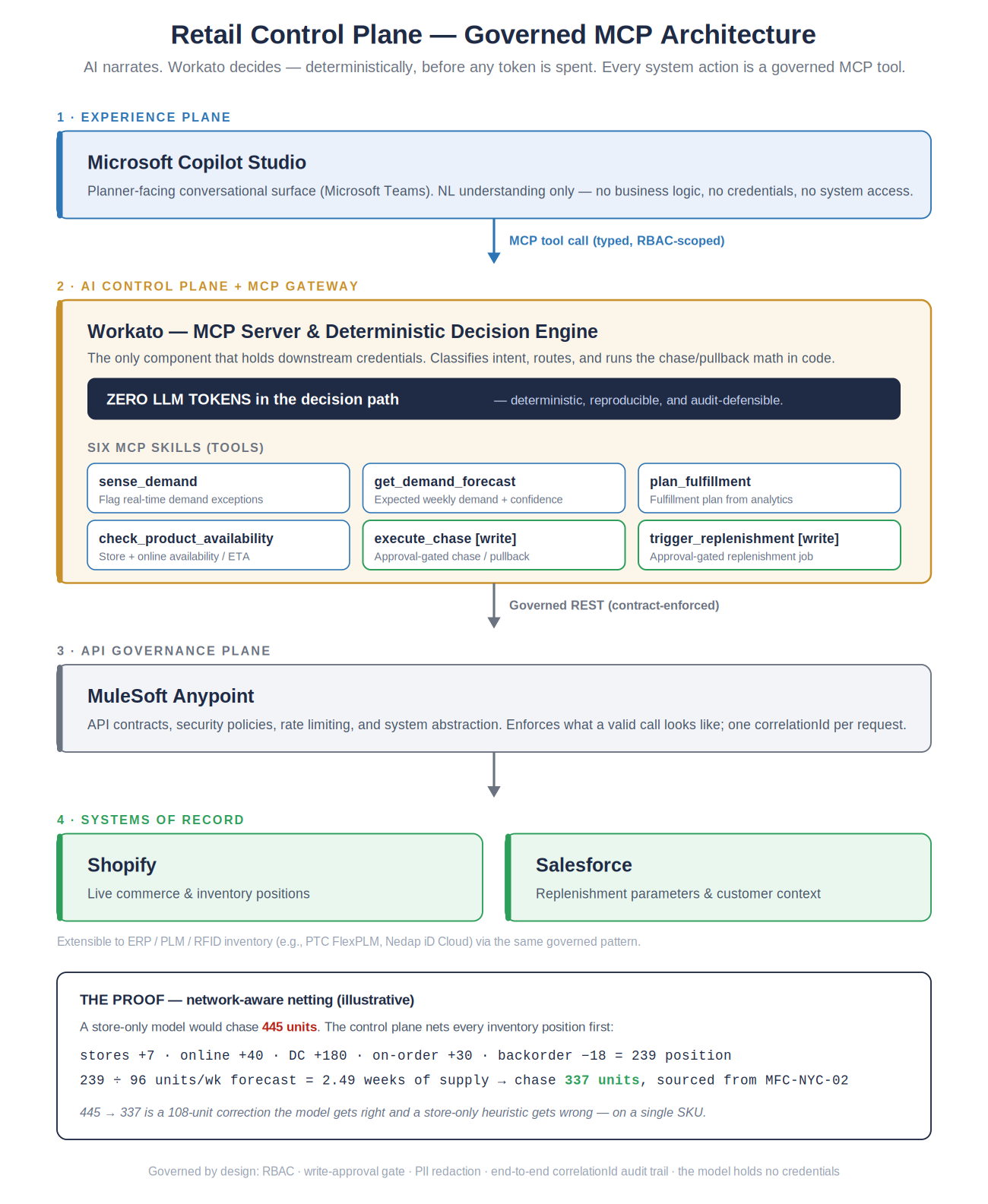
Microsoft Copilot Studio is the planner-facing conversational surface; every action it takes is a typed MCP tool call into Workato. Workato is the only component that holds downstream credentials. It classifies intent, then runs the chase/pullback decision entirely in deterministic code — zero LLM tokens are spent on the math, so every recommendation is reproducible and survives a finance and security review. MuleSoft governs the API contracts beneath Workato; Shopify and Salesforce are the live systems of record.
The server exposes six MCP skills: sense_demand, get_demand_forecast, plan_fulfillment, check_product_availability, and the two approval-gated write actions execute_chase and trigger_replenishment. Its differentiator is network-aware netting: instead of an inflated store-only chase, it nets every inventory position (stores, online, DC, on-order, backorder) into a weeks-of-supply figure and recommends the right quantity.
Target users are demand and merchandise planners, allocation and replenishment teams, and the enterprise-AI/architecture owners who must keep agentic AI governed. It deploys on the customer’s existing Workato + Copilot Studio + MuleSoft stack as a reusable RLCM manifest — not a new silo.
Sense a real-time demand exception on a style/SKU and quantify the gap vs. forecast before it becomes a stockout or overstock.
Recommend a network-aware chase quantity that nets stores, online, DC, on-order and backorder — not an inflated store-only number.
Recommend a pullback / markdown-avoidance action when demand softens, to prevent overstock.
Check real-time product availability and the fastest fulfillment option across stores and online for a region.
Route the recommended action through planner approval and execute it against the system of record as a governed, audited transaction.